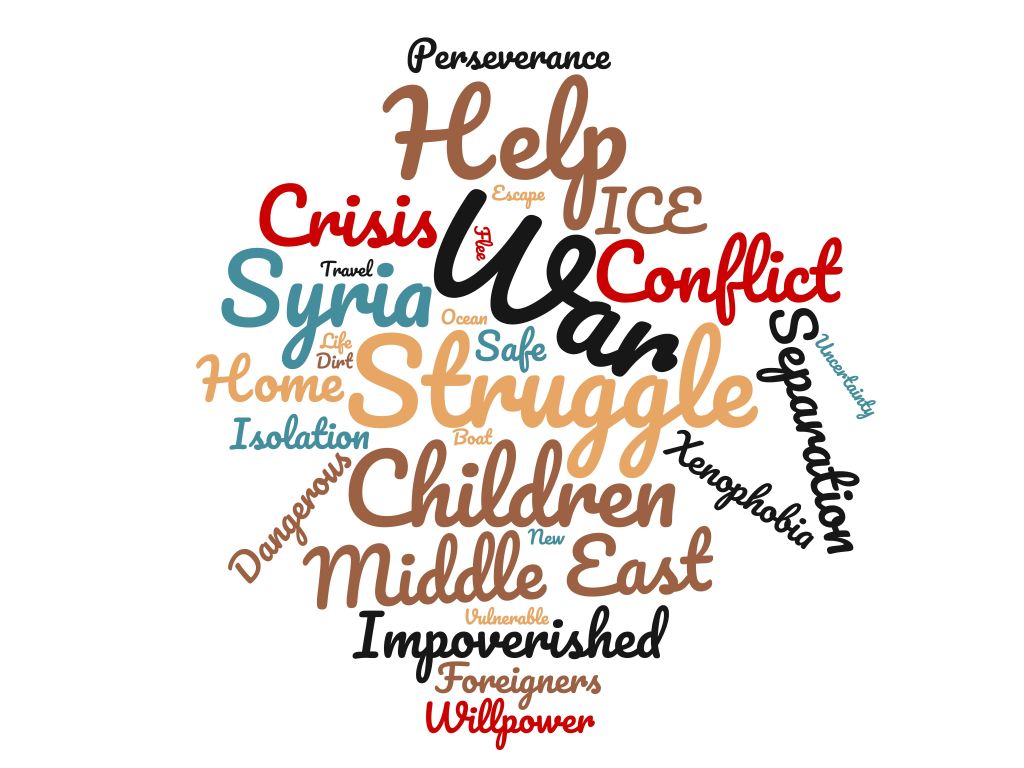
After gathering the words for the word association game, I was not surprised by the results. Many of these words fit the dominant cultural narratives surrounding refugees and their experience. The most repeated words, seen in large font, are “struggle”, “help”, and “war”. These worlds, as well as “crisis”, “conflict”, “escape”, “flee”, “separation”, and “vulnerable”, fit the overall theme of struggle. “Willpower”, “perseverance”, and “life” fit a promising trope.
Notably, “Syria” and “Middle East” were also recurring words, speaking to parts of the world. These two words came back to back when mentioned, so the interviewees who thought of these words connected them together. This shows how individuals from the Middle East come to mind over any other part of the world as no other countries were mentioned. It is as if ‘refugee-ness’, the qualities and characteristic regularly associated with and assigned to refugee identity, is defined by/ composed of a Middle-Eastern identity (Audio Lecture 1).
However, according to “The Global Flow of People” from Module 1, the largest flow of refugees coming into North America were from Latin America (3.5 million+) and South Asia (1.5 million+). Only approximately 170,000 refugees to North America came from West Asia, which includes Iran, Syria, Turkey, Iraq, Yemen, Saudi Arabia, etc. So this raises the question of why Syria and the Middle East are most often associated with the term refugee?
When I asked these individuals why they answered the way they did, they responded that the Middle Eastern demographic is predominantly displayed as refugees in the news and media they view. One referred to Syrian refugee crisis that was highly reported on by news outlets and another brought up ISIS. It is clear that, the role of news, media, and cultural production have played a key role in shaping cultural understandings of the refugee identity.
The results from generated from this word association exercise reveals the influence by the media on the stories and experiences of refugees. Critical refugee studies are critical in combatting the flawed narratives of institutional mandates.
 CMNS423 ePortfolio #1